Digital Marketing for Personal Injury Lawyers: What Actually Works in 2026
Learn what digital marketing for personal injury lawyers actually works in 2026. Covers Google LSA, SEO, social, email, and intake optimization.

Rafael Hernandez
CEO and Co-Founder of Great Marketing AI


I hope you find this useful. If you want our team to run your law firm's performance marketing, book a strategy call.
Author: Rafael Hernandez | CEO and Co-Founder of Great Marketing AI
Key Takeaways
- Digital marketing for personal injury lawyers in 2026 requires running multiple channels in parallel: Google Local Services Ads, SEO, paid social, and email nurture all work together.
- Google Local Services Ads now consistently outperform traditional Google Search Ads for personal injury firms, with lower cost per case and pre-vetted prospects.
- SEO and content marketing remain the highest-ROI long-term investment because they compound. A blog post that ranks today drives leads for years.
- Social media for personal injury lawyers is about trust-building and referral amplification, not direct case acquisition. Different metrics, different goals.
- The intake process determines whether your digital marketing spend converts. Even great campaigns fail when leads sit unanswered for hours.
The digital marketing landscape for personal injury law firms has shifted dramatically over the past two years. Channels that produced reliable case flow in 2023 now struggle with rising costs and saturated competition. Channels that were experimental have become mainstream. This guide covers what actually works in 2026 for digital marketing for personal injury lawyers, with specific tactics for each channel and how they fit together.
The State of Digital Marketing for Personal Injury Law Firms in 2026
The fundamental challenge for personal injury law firms is that almost every other firm wants the same cases. Motor vehicle accidents, slip and fall claims, and serious injury cases all carry high case values, which means every attorney is willing to spend aggressively to acquire them. The result is the most expensive digital advertising market in any vertical.
This competitive pressure makes channel diversification essential. Personal injury firms that rely on a single source for case acquisition expose themselves to two risks. Costs in any one channel can spike unpredictably, and platform changes can eliminate visibility overnight. Firms running three to five channels in parallel build resilience and compound their visibility across the entire customer journey.
The other major shift is the rise of AI-powered consumer behavior. Prospects increasingly research attorneys through ChatGPT, Perplexity, and Google AI Overviews before ever clicking a paid ad. This makes content quality and reputation signals more important than ever, because AI systems aggregate information from multiple sources before recommending specific firms.
Google Local Services Ads: The Highest-Intent Channel
Google Local Services Ads have become the most efficient paid channel for personal injury law firms. Unlike traditional Search Ads, you pay per lead rather than per click, which dramatically improves cost predictability. Google also pre-screens prospects through their verification system, filtering out tire kickers and competitors clicking your ads.

The verification process for LSA requires legitimate firm credentials, bar membership confirmation, and insurance verification. This creates a meaningful barrier to entry that limits the total number of firms competing for the same placements. In most markets, this means LSA inventory is less saturated than Search Ads.
Setting up Google Local Services Ads for personal injury cases requires careful service category selection. Choose specific practice areas that match your firm's focus rather than checking every available option. Firms that select narrow categories typically see higher quality leads because Google can route prospects to specialists rather than generalists.
The Google Guaranteed badge that appears with LSA placements adds significant trust. Prospects see the badge alongside your firm name and assume Google has verified your legitimacy, which improves click-through and conversion rates compared to standard Search Ads. Maintain a strong response rate and high review average to keep the badge active and improve your ranking within LSA results.
Budget management in LSA is simpler than Search Ads because you set a weekly budget and Google delivers leads within that budget. Costs typically run between $40 and $150 per lead for personal injury cases, depending on market and category. Compare this against the $250 average cost per lead on Facebook or $300 per click on Google Search Ads, and the economics become obvious.
SEO and Content Marketing: The Long-Term Foundation
Search engine optimization remains the highest-ROI long-term investment for digital marketing for personal injury lawyers. The leads SEO generates have no ongoing media cost, which means a blog post or practice area page that ranks on Google can generate cases for years.

Local SEO is the priority for most personal injury firms. Optimizing your Google Business Profile, accumulating reviews, building local citations, and creating location-specific content all contribute to ranking in the local pack that appears at the top of relevant searches. Firms ranking in the local pack receive disproportionate clicks compared to traditional organic results below.
Content marketing layered on top of local SEO accelerates results. A practice area page about car accidents in Los Angeles can rank for dozens of related queries when supported by blog posts answering common questions prospects search before contacting an attorney. Topics like statute of limitations, what to do after an accident, and how settlements work all drive traffic from research-stage prospects.
The shift toward AI search results has changed how SEO content needs to be structured. Pages that rank well in AI Overviews tend to have clear question-and-answer formatting, specific factual claims with citations, and authoritative voice. Personal injury firms publishing comprehensive guides with this structure consistently outperform competitors using older content formats.
Technical SEO matters more than most law firms realize. Site speed, mobile experience, and proper schema markup all influence rankings. Pages with proper Attorney schema, FAQ schema, and review schema get richer search result presentations that improve click-through rates significantly. Most law firm websites have significant technical SEO problems that compound to limit organic growth.
Social Media and Email Nurture: Staying Top of Mind
Social media for personal injury lawyers operates differently than for most businesses. Direct case acquisition through social ads exists, but the larger value is trust-building and referral amplification. People who follow your firm on social media for months often refer friends and family who need legal services, even if they never become clients themselves.
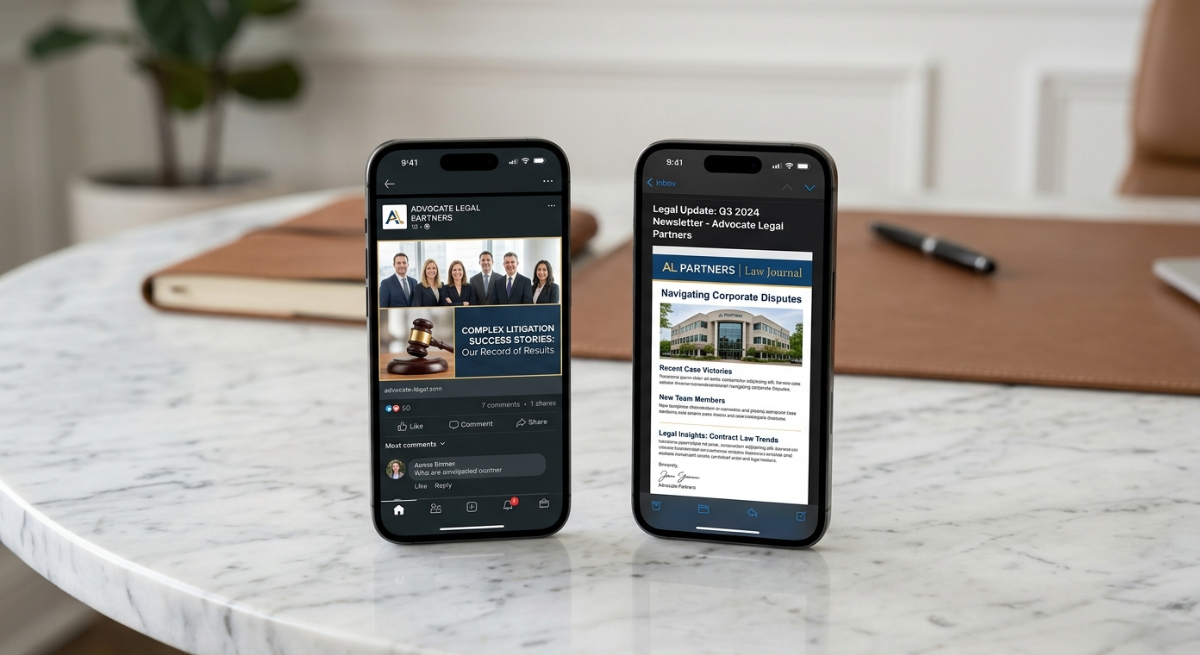
Content strategy for social media should mix educational posts, behind-the-scenes glimpses of the firm, attorney spotlights, and case result celebrations. Posts that show the human side of the practice consistently outperform purely promotional content. Facebook and Instagram remain the highest-impact platforms for personal injury firms targeting consumer prospects, while LinkedIn matters more for firms doing referral work with other attorneys.
Email nurture sequences fill a critical gap between initial inquiry and signed retainer. Many personal injury prospects need days or weeks to decide on representation, and firms without nurture sequences lose those slow-decision prospects to competitors who stay in touch. Automated email sequences can deliver case timelines, answers to common questions, and gentle reminders about consultation availability over multiple weeks.
Personalized email outreach to existing contacts produces some of the highest conversion rates in all of personal injury marketing. Past clients, referral sources, and even cold prospects who downloaded content but never converted can be reactivated through thoughtful email campaigns. The technical setup requires basic email marketing software like Mailchimp, ActiveCampaign, or HubSpot, plus careful list segmentation by prospect stage.
From Lead to Signed Case: The Intake Process
The best digital marketing for personal injury lawyers fails when the intake process is weak. Studies consistently show that response time is the single biggest predictor of whether a lead converts to a signed client. Leads contacted within five minutes of submission convert at significantly higher rates than leads contacted hours later.

Most personal injury firms underinvest in intake infrastructure relative to their advertising spend. Spending $30,000 per month on digital marketing while leaving the intake to whoever happens to answer the phone wastes a substantial portion of that investment. Dedicated intake specialists or specialized intake services often pay for themselves through improved conversion rates.
The intake conversation itself requires structure. Establishing case viability through specific qualifying questions, demonstrating empathy for the prospect's situation, explaining the firm's value proposition concisely, and setting clear expectations for next steps all contribute to higher conversion rates. Scripted intake processes that account for different case types and prospect circumstances perform better than ad-hoc conversations.
Automated follow-up sequences should kick in immediately for any lead that does not sign during the initial conversation. Text messages, calls, and emails distributed across the first 72 hours after inquiry recapture a meaningful percentage of prospects who hesitate during initial contact. CRM integration with marketing automation tools makes these sequences reliable rather than dependent on staff remembering to follow up.
Tracking case progression from lead source through signed retainer reveals which digital marketing channels actually produce profitable cases versus those that generate volume without conversion. Many personal injury firms discover through proper tracking that channels they assumed were profitable are actually losing money because the leads do not convert at acceptable rates.
Measuring What Actually Works
The metrics that matter for digital marketing for personal injury lawyers go beyond impressions and clicks. Cost per signed case is the only metric that determines whether each channel is profitable, and tracking it requires CRM integration that connects every lead back to its original campaign.
Build a monthly dashboard tracking cost per lead, lead-to-signed-case conversion rate, and cost per signed case for each marketing channel. Compare cost per signed case against your average case value to identify profitable versus unprofitable channels. Channels with consistently high cost per signed case need either creative refresh, targeting adjustments, or budget reallocation.
Attribution becomes complex when prospects encounter multiple touchpoints before converting. Someone who sees your Facebook ad, later searches your firm name on Google, then converts through your website is influenced by both channels. Multi-touch attribution tools like HubSpot or specialized legal marketing platforms reveal these patterns and help allocate credit appropriately across channels.
Reviewing performance trends over rolling three-month windows provides better signal than monthly snapshots. Personal injury case flow varies seasonally, and individual months can show misleading spikes or dips. Quarterly review against rolling averages reveals genuine performance changes versus normal variability.
Conclusion
Digital marketing for personal injury lawyers in 2026 demands a multi-channel approach grounded in measurement and continuous optimization. Google Local Services Ads provide the most efficient paid channel for high-intent prospects. SEO and content marketing compound over time into a long-term competitive advantage. Social media and email nurture maintain visibility and convert hesitant prospects. The intake process determines whether all of it produces actual signed cases. Firms that build discipline across every component outperform competitors with bigger budgets and weaker execution. Start with the channel that fits your firm's stage, measure relentlessly, and expand systematically as each channel proves its economics.
Turn Ad Spend Into Signed Cases
We blend AI-driven testing with proven performance strategy to attract qualified traffic and turn it into revenue—fast, trackable, and scalable.
- PI Lead Generation — exclusive, AI-qualified leads across MVA, slip & fall, med mal, and more.
- Facebook & Instagram Ads — reach customers where they scroll.
- Google Ads — capture people actively searching for you.
- Website Design — turn visitors into buyers with high-converting sites.
- AI Automations — save hours and never miss a follow-up.
- Email Marketing — nurture leads and close sales on autopilot.
- SEO — get found by customers searching for what you sell.
FAQs

About the author
Rafael Hernandez
CEO and Co-Founder of Great Marketing AI
Rafael Hernandez is the Founder of Great Marketing AI and a former Microsoft Engineer. He specializes in performance marketing for personal injury law firms, managing over $10M in ad spend to help attorneys generate signed cases across every PI case type. His strategies focus on exclusive lead generation, AI-powered qualification, and eliminating wasted budget.
About Great Marketing AI
Great Marketing AI: Performance marketing for personal injury law firms
We help personal injury law firms scale with exclusive, AI-qualified leads across every PI case type: MVA, slip & fall, medical malpractice, and wrongful death. Native English and Spanish campaigns, enterprise-grade Meta + Google ad management, and AI lead qualification before every intake.
100% Exclusive Leads
Never shared between firms. Territory-protected.
Native Spanish & English Campaigns
Built by native speakers, not Google Translate.
AI Lead Qualification
Pre-qualified before they ever reach your intake team.