Google Local Service Ads for Personal Injury Lawyers: The Complete Setup Guide
Step-by-step guide to setting up Google Local Service Ads for personal injury lawyers. Get the Google Guaranteed badge, set your budget, and lower your cost per signed case.

Rafael Hernandez
CEO and Co-Founder of Great Marketing AI

I hope you find this useful. If you want our team to run your law firm's performance marketing, book a strategy call.
Author: Rafael Hernandez | CEO and Co-Founder of Great Marketing AI
Key Takeaways
- Google Local Service Ads for personal injury lawyers charge per lead (not per click), with costs typically ranging from $80 to $150 per verified lead in 2026.
- The Google Guaranteed badge requires background checks, state bar license verification, and malpractice insurance confirmation before your ads can go live.
- LSAs consistently outperform traditional Google Search Ads on cost per signed case for PI firms because leads arrive pre-qualified and Google-verified.
- Setting your weekly budget cap at 3x your target cost-per-lead prevents budget exhaustion without limiting Google's ability to find high-quality leads.
- PI firms that maintain a 4.0+ star review rating with 40+ reviews capture significantly more LSA impressions than competitors with fewer or lower-rated reviews.
Google local service ads for lawyers put your firm at the very top of Google search results, above all paid search ads and organic listings, with a Google Guaranteed badge that signals verified credentials to injury victims searching right now. Unlike traditional pay-per-click campaigns where you pay for every visitor, LSAs charge only for leads: real phone calls and messages from prospective clients who contacted your firm.
For personal injury attorneys, this distinction matters more than in almost any other legal category. CPC costs for PI keywords routinely exceed $150 per click, meaning a single Google Search Ad campaign can exhaust a five-figure monthly budget without producing a single signed case. LSAs flip that equation. You pay $80 to $150 per verified lead, and Google credits back the ones that do not qualify. The result, for most PI firms that run both formats, is a 20 to 35 percent lower cost per signed case through LSA than through traditional Google Ads.
This guide walks through the complete setup process from application to live campaign, including the verification requirements specific to personal injury attorneys, budget strategy, and the comparison data you need to make an informed decision about how LSAs fit into your overall paid acquisition strategy.
Key Takeaways
- Local service ads for lawyers use pay-per-lead pricing ($80 to $150 per verified PI lead) rather than pay-per-click, lowering cost per signed case by 20 to 35 percent compared to Search Ads for most PI firms.
- The Google Guaranteed badge requires state bar license verification, malpractice insurance confirmation, and a background check before ads go live.
- The verification process takes 2 to 4 weeks. Insurance certificate uploads inside the LSA dashboard accelerate the timeline.
- Weekly budget caps at 3x your target cost-per-lead prevent exhaustion while giving Google room to optimize lead quality.
- Review rating and recency are the strongest LSA ranking factors after verification status. Firms with 4.5+ stars and 40+ reviews dominate impression share in their zip code.
How Google Local Service Ads Work for Personal Injury Attorneys
Google local service ads for personal injury lawyers appear in a dedicated carousel at the top of Google search results, above both paid search ads and the organic listings. The format shows your firm name, star rating, review count, years in business, and the Google Guaranteed badge, all before a potential client visits your website.
The pay-per-lead model is the defining feature. When a prospective client calls your firm or sends a message through the LSA interface, that interaction counts as a lead, and Google charges your account. If the lead does not meet your specified criteria, you can dispute it within 30 days for a credit. According to Google's own LSA data, personal injury firms that actively dispute ineligible leads recover 15 to 25 percent of their monthly spend through credits, effectively reducing their real cost per lead.
The local service ads for law firms platform also handles basic lead management. Every call is recorded (with mandatory disclosure), contacts are logged in a built-in CRM, and you can mark leads as booked, archived, or disputed. For PI firms managing high call volume, this built-in call tracking and intake logging reduces the risk of leads slipping through gaps in your intake process.
Verification Requirements for Personal Injury Lawyers
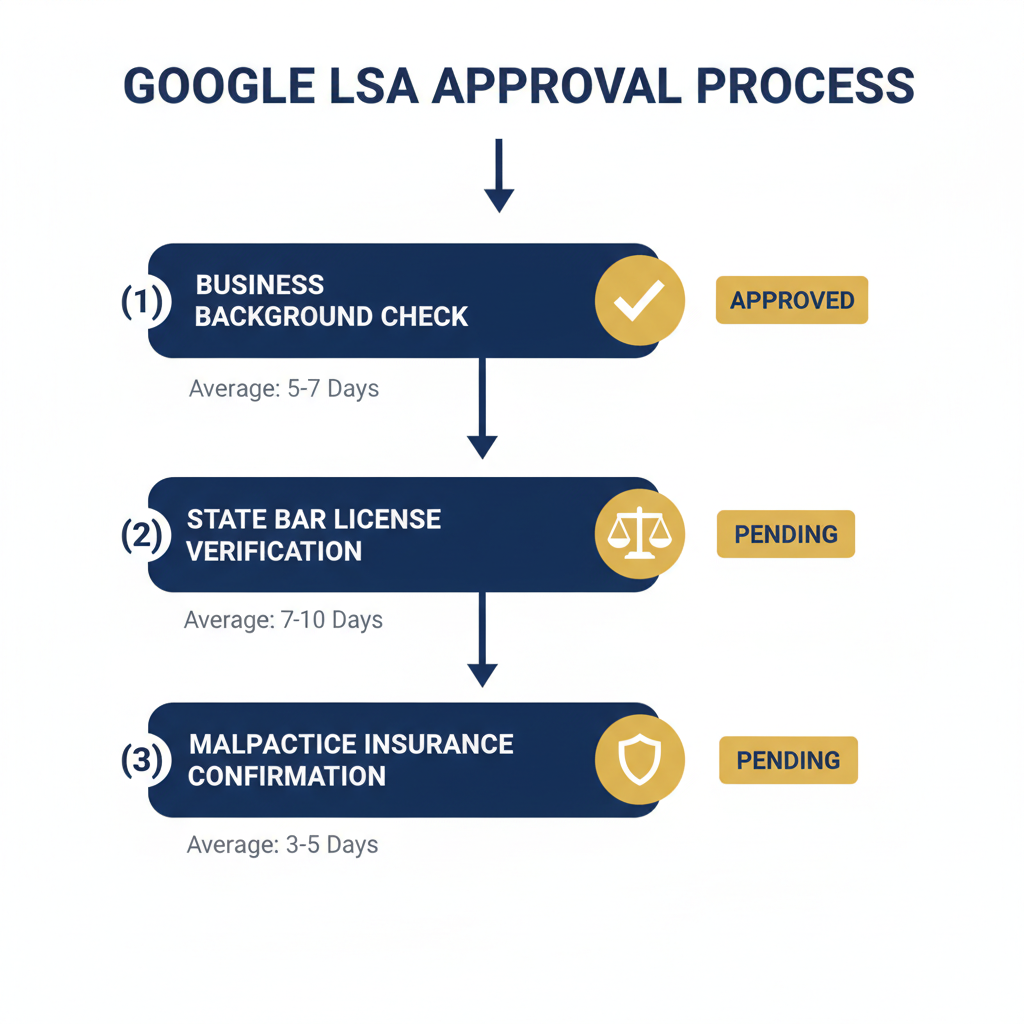
Obtaining the Google Guaranteed badge for a PI law firm involves three distinct verification checks that run in parallel after you submit your application.
Business background check. Google's third-party background check partner screens the business entity and key personnel, including managing partners and any staff listed on the account. This check reviews criminal records, regulatory violations, and business license status. Most PI firms clear this step within 3 to 7 business days.
State bar license verification. Google contacts your state bar directly to confirm your active license, current standing, and practice area designations. This is typically the longest step because it depends on state bar response times. California, New York, and Texas bar associations generally respond within 5 to 7 days. Smaller state bars may take 10 to 14 days. The LSA platform allows you to add your bar number and state bar registration URL to expedite the lookup.
Malpractice insurance confirmation. Google requires proof of current professional liability coverage. Upload your certificate of insurance directly in the LSA business settings dashboard. This direct upload bypasses the insurer-contact pathway and typically clears within 2 to 5 business days. Your certificate must show coverage that is current, not expiring within 30 days of submission.
Attorney screening and practice area categories. When setting up your LSA profile, select your primary practice area categories carefully. Personal injury is a top-level category. You can add subcategories including motor vehicle accidents, slip and fall, wrongful death, and medical malpractice. Google only shows your ads for queries that match your selected categories, so including all relevant subcategories ensures you capture the full range of PI case types your firm handles.
Setting Your LSA Budget for a PI Firm
Local service ads for law firms use a weekly budget structure, not a monthly cap. Google distributes your weekly budget across the days of the week and adjusts delivery based on real-time demand, meaning you may spend more on Mondays and Tuesdays (peak legal query days) and less on weekends.
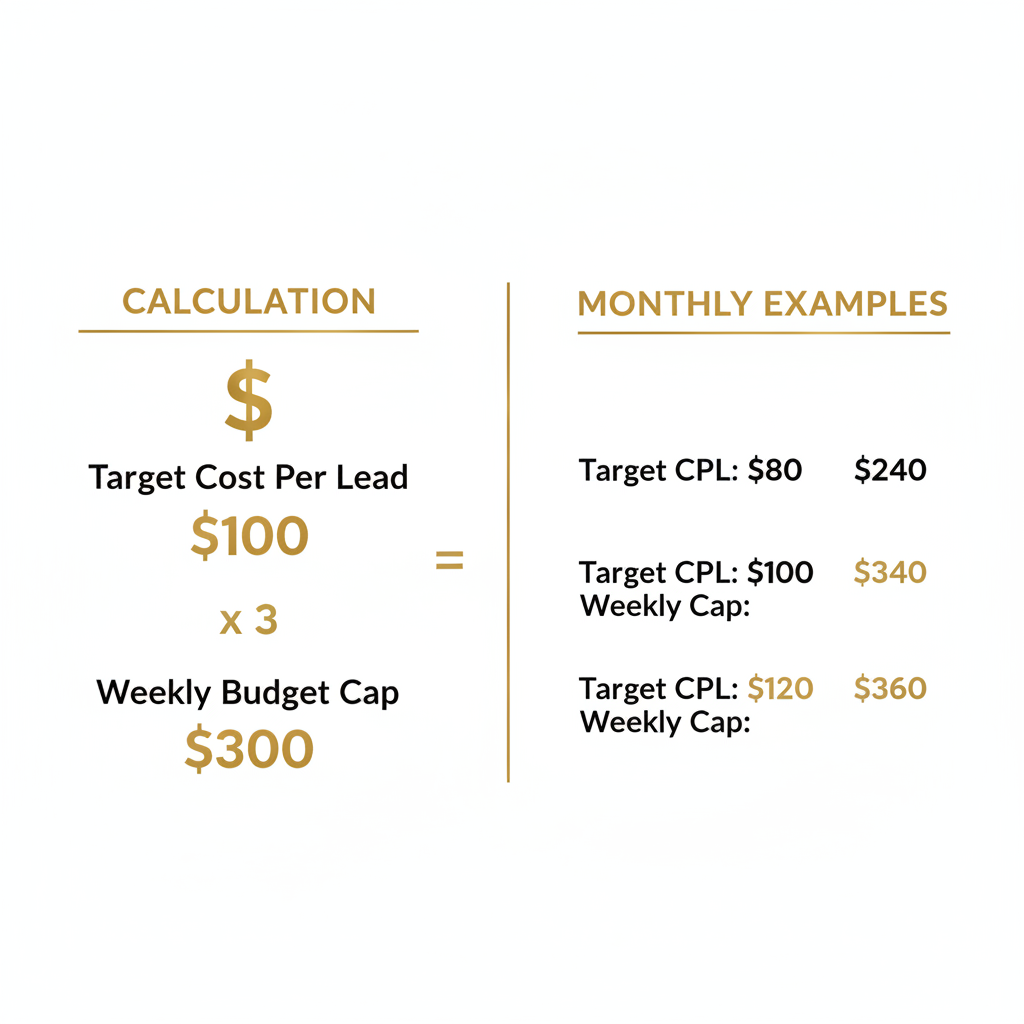
The 3x budget formula. Set your weekly budget cap at three times your target cost-per-lead. If your target is $100 per lead, set a $300 weekly cap. This ceiling prevents budget exhaustion during high-demand periods while giving Google's bid strategy algorithm enough room to find quality leads. Firms that set weekly caps too close to their CPL target often see Google throttle delivery because the algorithm cannot optimize within too narrow a spending window.
Seasonal adjustments. Motor vehicle accident lead volume spikes in January and February (post-holiday driving increases) and again in June through August (summer road traffic). Raise your weekly budget cap by 20 to 30 percent during these months to capture additional volume. The budget cap can be adjusted in the LSA dashboard at any time without resetting campaign performance data.
The CPC vs CPL comparison for PI attorneys. The table below draws on data from our own campaign management across PI clients to illustrate typical cost differences between ad formats for comparable case intakes.
| Ad Format | Cost Model | Avg. Cost Per Lead (PI) | Avg. Cost Per Signed Case | Best For |
|---|---|---|---|---|
| Google LSA | Pay-per-lead | $80 to $150 | $800 to $1,600 | Verified phone leads, budget predictability |
| Google Search Ads | Pay-per-click | $150 to $400 per click | $1,500 to $4,000 | Specific keyword targeting, remarketing |
| Facebook Ads (Lead Forms) | Pay-per-lead | $20 to $60 | $1,200 to $3,500 | Awareness, Spanish-speaking audiences, video |
Google LSAs produce the lowest cost per signed case for most PI firms because leads arrive pre-filtered: the prospect searched specifically for a personal injury attorney, saw the Google Guaranteed badge, and chose to call. The intent and friction removal are built into the format. Facebook Ads can produce lower nominal cost per lead but require stronger intake processes to convert form fills into signed cases.
For ppc for lawyers who are evaluating which platform to prioritize with a limited budget, LSA is the starting point. The ad rank factors that determine your position in the LSA carousel are simpler and more controllable than Search Ads Quality Score, making results more predictable for new campaigns. If you are still weighing the two channels against each other, our breakdown of local service ads vs Google Ads for lawyers compares cost model, SERP placement, and lead quality side by side.
Getting and Protecting Your Google Guaranteed Badge
The Google Guaranteed badge appears as a green checkmark next to your firm name in the LSA carousel. It is not cosmetic. Research from BrightLocal's 2025 Local Consumer Review Survey found that 78 percent of consumers say a trust badge influences their decision to contact a business over a competitor. For personal injury clients choosing between multiple attorneys in a moment of stress, the badge provides immediate credibility that takes minutes to perceive but months to earn.
Maintaining badge status. The badge is revocable. Google's dispute resolution process for badge violations includes warnings for high complaint rates, temporary suspensions for unresolved disputes, and permanent removal for license violations or background check changes. Firms that let malpractice insurance lapse, change key personnel without updating the account, or receive multiple complaints without resolution risk losing their badge and all campaign history.
Review threshold management. Google's LSA ranking algorithm weights review scores more heavily than budget in most markets. A personal injury law firm marketing agency like ours consistently sees firms with 4.5+ stars and 40+ reviews outperform higher-budget competitors with lower ratings. The most effective review strategy for PI firms is a post-close text or email to every satisfied client with a direct link to the Google review form, sent within 48 hours of case resolution.
LSA verification renewal. Background checks must be renewed annually. Set a calendar reminder 60 days before your verification anniversary. Lapsed verification suspends your campaigns automatically. Malpractice insurance certificates must also be updated when policies renew, which does not happen automatically even when you renew with the same insurer.
Optimizing Your LSA Profile for Maximum Impressions
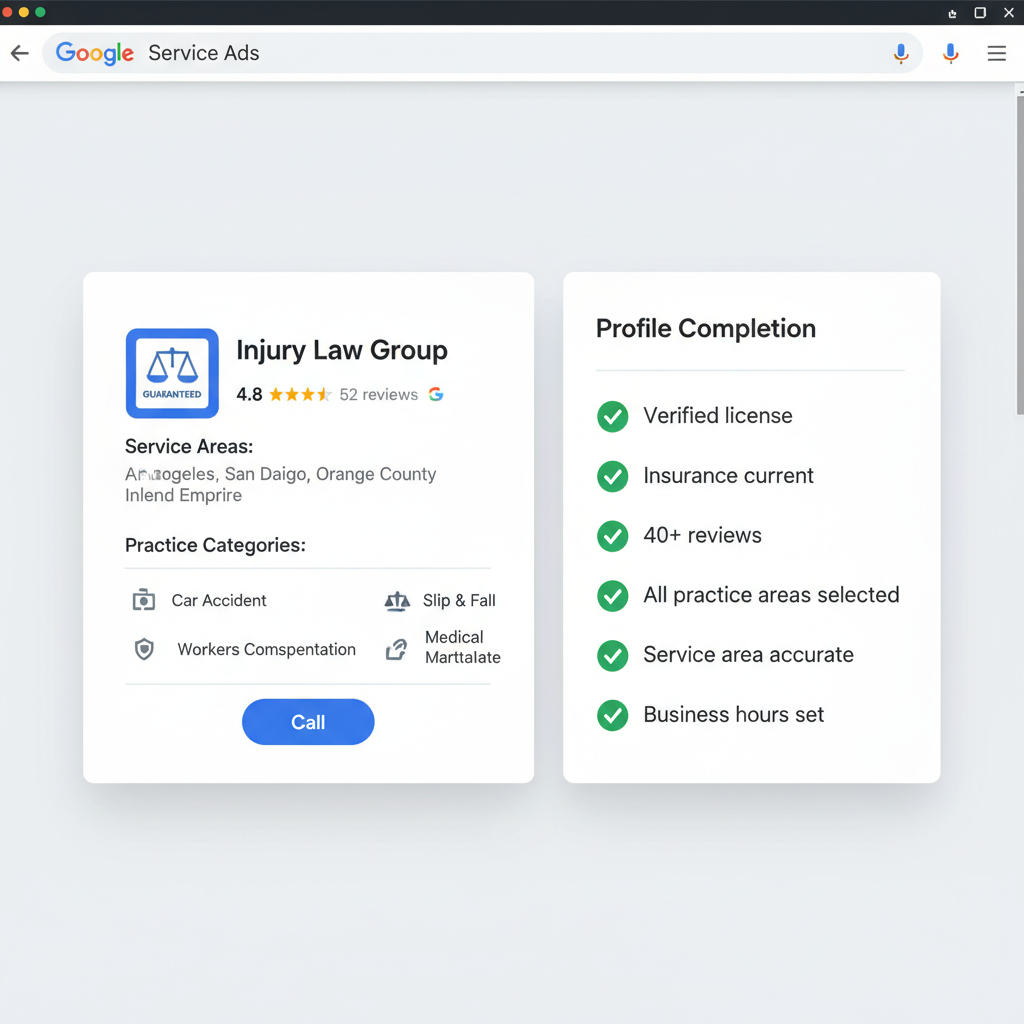
Google local service ads for lawyers rank based on factors you control: verification status, review score and volume, responsiveness, and profile completeness. Understanding which levers move the needle most efficiently saves you months of trial-and-error.
Service area precision. Set your service area to the zip codes where your firm actually handles cases, not the widest possible geographic radius. Google's algorithm penalizes service areas that are too large relative to your review geography, because it interprets oversized areas as firms chasing leads outside their true market. For a Los Angeles PI firm, specifying the city and immediate surrounding zip codes outperforms claiming all of Southern California.
Business hours and responsiveness. LSA tracks your lead quality in part by response time. Firms that answer calls during stated business hours, respond to messages within the first hour, and maintain low missed-call rates rank higher than firms with identical review scores but poor responsiveness. If your intake team operates 8 AM to 6 PM, set your LSA hours to 8 AM to 6 PM exactly. Do not set 24-hour hours if you cannot staff them; unanswered after-hours calls count as responsiveness failures.
Intake form and phone number settings. For PI firms with dedicated intake teams, routing LSA calls directly to the intake line (not the main reception) improves conversion rates. The LSA platform allows you to set a dedicated forwarding number, ensuring that every lead is tracked separately from organic calls and other campaigns.
Google's LSA vs Google Ads interface provides a separate reporting dashboard for LSA that shows leads by status, dispute history, and review requests sent. Review this dashboard weekly, not monthly. Catching and disputing bad leads within the 30-day window is the single highest-return maintenance task for active LSA campaigns.
For broader context on managing Google Ads for lawyers including Search Ads, Display, and Performance Max campaigns alongside LSA, see our Google Ads for lawyers guide with full PPC strategy and budget benchmarks.
Common LSA Mistakes PI Firms Make
Selecting too few practice area categories. Attorneys who select only "Personal Injury" without adding subcategories (motor vehicle accidents, wrongful death, slip and fall) miss searches that use subcategory-specific language. Each subcategory you add is an additional set of queries your ads can appear for.
Ignoring the lead credit process. Many firms dispute fewer than 5 percent of leads when the appropriate dispute rate for a well-monitored PI campaign is 15 to 25 percent. Spam calls, wrong-number calls, and out-of-area inquiries are creditable. Leaving disputed credits uncollected is equivalent to overpaying for leads you never converted.
Setting and forgetting review requests. The LSA dashboard includes an automated review request feature that sends a follow-up to leads who contacted you. This should be used alongside, not instead of, your firm's direct post-close review requests. Automated LSA review requests go to all leads including those that did not become clients, which lowers your average review sentiment compared to manual post-close requests sent only to satisfied clients.
LSA verification lapses. Malpractice insurance policies that renew automatically in your insurer's system do NOT automatically update in your LSA account. You must upload the new certificate of insurance when each policy renews or Google will suspend your campaigns on the verification anniversary. Build a shared calendar event with your office manager and your marketing team so this does not fall through the cracks.
As a personal injury law firm marketing agency that manages LSA campaigns across multiple markets, we see these four mistakes account for the majority of underperformance in otherwise well-configured campaigns.
Conclusion
Google local service ads for lawyers offer personal injury attorneys the most cost-predictable entry point into Google's paid ecosystem. The pay-per-lead model, Google Guaranteed badge, and built-in dispute credits combine to produce a lower cost per signed case than traditional Search Ads for most PI firms that complete the verification process correctly.
The setup requires patience: 2 to 4 weeks for verification, another 4 to 6 weeks for the algorithm to optimize lead quality in your market. Firms that commit to active maintenance, including weekly dispute reviews, post-close review requests, and prompt insurance certificate updates, consistently outperform competitors who treat LSA as a set-and-forget channel.
If you are ready to launch local service ads for law firms or want a team that manages the entire setup and ongoing optimization process for your PI practice, we work exclusively with personal injury firms and can have your campaign fully verified and live in under four weeks.
Turn Ad Spend Into Signed Cases
We blend AI-driven testing with proven performance strategy to attract qualified traffic and turn it into revenue—fast, trackable, and scalable.
- PI Lead Generation — exclusive, AI-qualified leads across MVA, slip & fall, med mal, and more.
- Facebook & Instagram Ads — reach customers where they scroll.
- Google Ads — capture people actively searching for you.
- Website Design — turn visitors into buyers with high-converting sites.
- AI Automations — save hours and never miss a follow-up.
- Email Marketing — nurture leads and close sales on autopilot.
- SEO — get found by customers searching for what you sell.
FAQs

About the author
Rafael Hernandez
CEO and Co-Founder of Great Marketing AI
Rafael Hernandez is the Founder of Great Marketing AI and a former Microsoft Engineer. He specializes in performance marketing for personal injury law firms, managing over $10M in ad spend to help attorneys generate signed cases across every PI case type. His strategies focus on exclusive lead generation, AI-powered qualification, and eliminating wasted budget.
About Great Marketing AI
Great Marketing AI: Performance marketing for personal injury law firms
We help personal injury law firms scale with exclusive, AI-qualified leads across every PI case type: MVA, slip & fall, medical malpractice, and wrongful death. Native English and Spanish campaigns, enterprise-grade Meta + Google ad management, and AI lead qualification before every intake.
100% Exclusive Leads
Never shared between firms. Territory-protected.
Native Spanish & English Campaigns
Built by native speakers, not Google Translate.
AI Lead Qualification
Pre-qualified before they ever reach your intake team.