Local Service Ads vs Google Ads for Lawyers: Which Wins for PI Firms (2026)
LSA vs Google Ads for lawyers compared head-to-head: cost model, SERP placement, Google Screened badge, lead quality, and when PI firms should run each or both.

Rafael Hernandez
CEO and Co-Founder of Great Marketing AI


I hope you find this useful. If you want our team to run your law firm's performance marketing, book a strategy call.
Author: Rafael Hernandez | CEO and Co-Founder of Great Marketing AI
Key Takeaways
- Local Service Ads charge per qualified lead and sit at the very top of the page with a Google Screened badge, while Google Ads charge per click and sit just below, so the two channels capture different parts of the same search.
- For most personal injury firms, LSAs deliver a lower cost per signed case because leads arrive Google-verified and pre-screened, but you trade away control over keywords, copy, and targeting.
- Google Ads win on control and case-type precision: you choose the keywords, the landing page, the geography, and the negative keywords that filter out tire-kickers before they ever call.
- The strongest 2026 play for PI firms is running both: LSAs for predictable pay-per-lead volume at the top, Google Ads underneath for case types and Spanish-language MVA queries LSAs cannot target.
- Bilingual firms chasing Spanish-speaking MVA claimants get more leverage from Google Ads, where Spanish keywords and Spanish landing pages are controllable, than from LSAs that Google matches automatically.
Local Service Ads versus Google Ads for lawyers comes down to one trade-off: pay-per-lead simplicity at the top of the page versus pay-per-click control just below it. Local service ads vs google ads is not really a question of which is better in the abstract. It is a question of what your personal injury firm needs right now. Local Service Ads charge you only when a qualified prospect contacts you, sit above every other result, and carry the Google Screened badge that comes from a license and insurance check. Google Ads charge per click, appear directly beneath LSAs, and hand you full control over keywords, copy, landing pages, and negative keywords. For most PI firms the honest answer in lsa vs google ads for lawyers is to run both, because each channel captures a different slice of the same injury-victim search. If forced to start with one, a smaller firm should begin with google local service ads for lawyers for predictable cost, then layer Google Ads on top once lead volume is stable.
Key Takeaways

LSA vs Google Ads: The Core Difference for Law Firms
The fastest way to understand local service ads vs google ads is to separate how you pay from what you control. Local Service Ads run on a pay-per-lead model: Google charges your firm only when a valid prospect calls or messages, and the contact must meet a quality threshold to be billable. Google Ads run on pay-per-click: you are charged every time someone clicks your ad, whether or not they ever become a lead.
Control is the second axis. With google local service ads for lawyers, Google decides the matching, the listing layout, and which searches trigger your ad. You cannot write the copy or pick keywords. With Google Ads, you control every lever: keywords, ad text, landing pages, bidding, scheduling, and geography. As Great Marketing AI scaled paid search across PI firms, the pattern held consistently: LSAs win on simplicity, Google Ads win on precision. A firm that needs hands-off lead flow leans LSA. A firm that needs to target one injury type in one zip code leans Google Ads.
SERP Placement: Who Sits Where
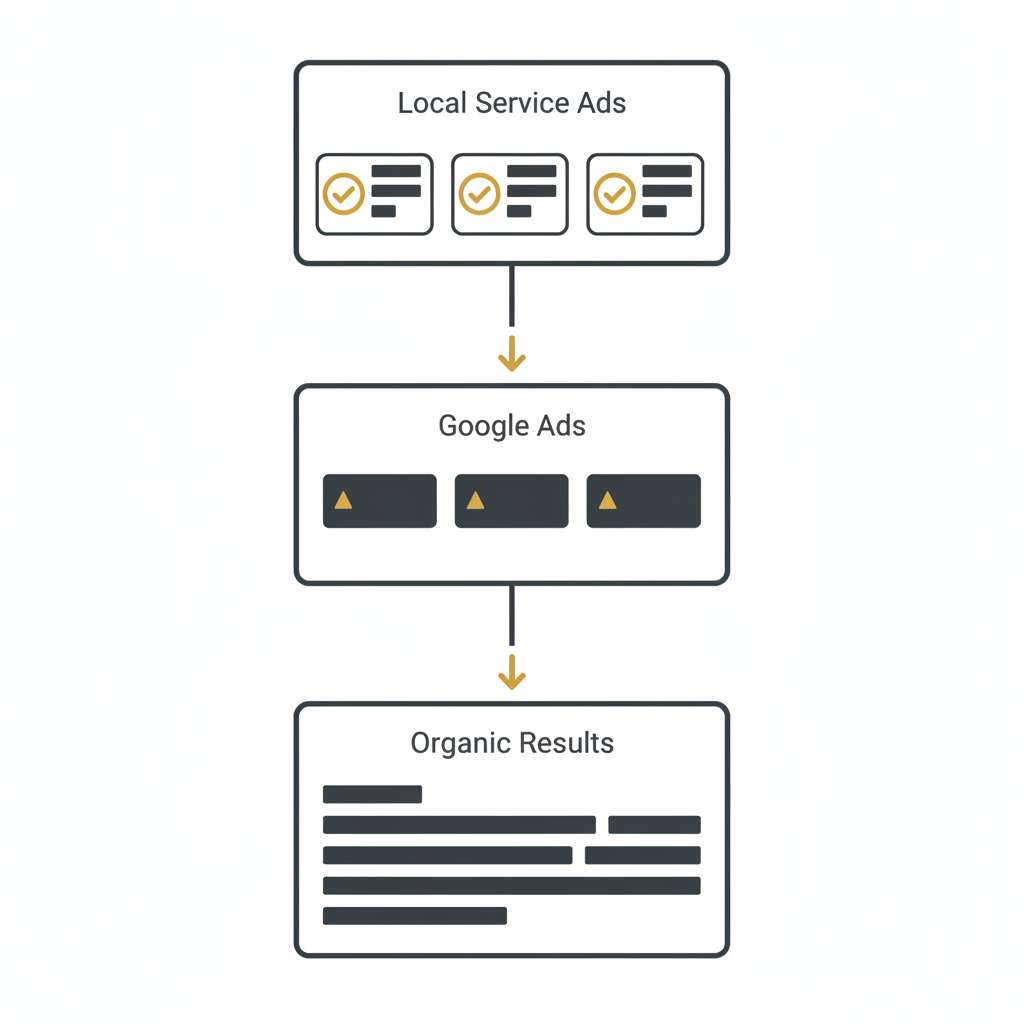
Position on the page is where lsa vs google ads for lawyers becomes visible to the searcher. Local Service Ads occupy the very top of the results page, above traditional Google Ads and above organic listings. According to Google's Local Services Help documentation, these pay-per-lead listings appear at the top of the page and feature the verified badge, which is prime real estate for a high-intent search like "car accident lawyer near me."
Google Ads sit in the next tier down, in the standard sponsored block beneath the LSA unit. That placement still beats organic results, but a searcher scanning top to bottom sees the Google Screened firms first. For an injury victim in pain who wants to call immediately, that ordering matters. The practical takeaway: LSAs win the first impression, Google Ads win the considered click. Running both means your firm can appear twice on the same page, once at the very top and once in the paid block, which compounds visibility for competitive personal injury queries.
Cost Model: Pay-Per-Lead vs Pay-Per-Click

The billing difference drives the economics. With Local Service Ads, Google charges you per valid lead, and leads judged invalid or low quality are not billed. You set an average weekly budget tied to how many leads you want, and you never exceed your monthly maximum. In personal injury markets, an LSA lead commonly runs $80 to $180 depending on city and competition.
Google Ads bill per click regardless of outcome. A single click on a top injury keyword in Los Angeles or New York can cost $150 to $400, and many of those clicks never convert. The metric that decides the winner is cost per signed case, not cost per lead or per click. A worked example from managing PI campaigns: at $120 per LSA lead with a 12 percent lead-to-signed rate, the cost per signed case is roughly $1,000. A Google Ads campaign at $250 per click needs a strong landing page and tight intake to match that. This is why our personal injury law firm marketing agency treats cost per signed case as the only number that settles the local service ads vs google ads debate.
A Quick Cost-Per-Case Worked Example
Run the same $6,000 monthly budget through each channel. On LSAs at $120 per lead, that buys 50 leads; at a 12 percent sign rate, you net 6 cases, or $1,000 per signed case. On Google Ads at $200 per click with a 5 percent click-to-lead rate, $6,000 buys 30 clicks worth of leads after intake, which can swing far higher per case unless your landing page and intake are sharp. The lesson is not that one channel is always cheaper. It is that LSAs forgive weak intake while Google Ads punish it.
The Google Screened Badge and Lead Quality

Google Screened is the verification layer that only Local Service Ads carry. Before a firm can run LSAs, Google verifies the state bar license, runs background checks, and confirms malpractice insurance. Once cleared, the green Google Screened checkmark appears in the listing, signaling that Google vetted the firm. Google Ads have no equivalent badge.
That trust marker lifts click-through, but LSA lead quality is uneven because Google controls the matching. You will occasionally pay for prospects outside your case types or people seeking free advice. The offset is the built-in dispute process: firms can request credits for spam, wrong-number, duplicate, or out-of-area leads. "The firms that win with LSAs treat lead disputes as a weekly habit, not an afterthought," says Rafael Hernandez, Founder and CEO of Great Marketing AI. "Disputing 15 to 25 percent of leads is normal, and the credits quietly drop your real cost per signed case." Google Ads control quality differently, through negative keywords and qualifying copy that filter poor-fit clicks before the call.
Control and Targeting: Where Google Ads Pull Ahead

When precision matters, Google Ads win the lsa vs google ads for lawyers comparison decisively. You choose exact-match keywords like "truck accident attorney free consultation," exclude wasteful terms with negative keywords, set bids by time of day, and route every click to a purpose-built landing page. According to the Performance Marketing Association, measurable, controllable paid channels are what let advertisers tie spend to outcomes, and Google Ads sit squarely in that category for law firms.
This control is decisive for bilingual MVA work. LSAs cannot target Spanish-language searches by keyword, but Google Ads can run Spanish campaigns, Spanish ad copy, and a Spanish landing page aimed at Hispanic motor vehicle accident claimants. Firms competing for motor vehicle accident leads in markets like Los Angeles, Houston, and Miami rely on that controllability because Google's automatic LSA matching will not deliberately segment a Spanish-speaking audience. For deeper paid-search tactics, our guide on Google Ads for law firms breaks down budgets and bidding, and the PPC for personal injury lawyers playbook covers which injury keywords actually convert.
Head-to-Head Comparison Table
| Factor | Local Service Ads (LSA) | Google Ads (PPC) |
|---|---|---|
| Pricing model | Pay-per-lead (billed per valid lead) | Pay-per-click (billed per click) |
| SERP placement | Very top, above paid and organic | Below LSAs, above organic |
| Google Screened badge | Yes, license + insurance verified | No |
| Typical PI cost | $80 to $180 per lead | $150 to $400 per click in top metros |
| Control over targeting | Minimal, Google matches automatically | Full keyword, geo, copy, and negative control |
| Spanish-language MVA targeting | Not controllable by keyword | Fully controllable campaigns and landing pages |
| Lead quality lever | Dispute and credit process | Negative keywords and qualifying copy |
| Best for | Firms wanting predictable, hands-off leads | Firms needing case-type and geo precision |
| Setup speed | 2 to 4 weeks for verification | Live within days |
A multi-option decision like this is exactly where a structured comparison beats prose. Use the table as your starting filter, then weigh it against your firm's intake capacity and budget. For the full LSA mechanics, our deep dive on Google Local Service Ads for personal injury lawyers walks through the setup, badge requirements, and budget caps step by step.
When to Use Each, and When to Use Both
The right answer in local service ads vs google ads shifts with your firm's stage. A new or budget-conscious PI firm should start with google local service ads for lawyers because pay-per-lead pricing is predictable and forgiving. You will not burn through a budget during a Google Ads learning period before any case signs. Once LSA volume is steady and profitable, add Google Ads to cover case types LSAs do not match, defend your brand name, retarget website visitors, and run controllable Spanish-language MVA campaigns.
Established firms with strong reviews and tight intake should run both from the start, because appearing in the LSA block and the paid block on the same page compounds visibility. According to WordStream's analysis of Local Services Ads, the channels are complementary rather than competing. The decision is rarely "either or." It is sequencing: LSA first for cost certainty, Google Ads layered on for precision and reach as soon as your intake can absorb the volume.
Conclusion
Local service ads vs google ads is not a winner-take-all contest for personal injury firms. LSAs deliver pay-per-lead simplicity, top-of-page placement, and the Google Screened trust badge, which usually produces a lower cost per signed case for firms with solid intake. Google Ads deliver control: the keywords, copy, geography, and Spanish-language MVA targeting that automatic LSA matching cannot. The firms that win in 2026 sequence both channels, starting with LSAs for predictable volume and adding Google Ads for case-type and bilingual precision. Match the channel to your stage, measure everything against cost per signed case, and let the two paid surfaces cover each other's gaps.
Turn Ad Spend Into Signed Cases
We blend AI-driven testing with proven performance strategy to attract qualified traffic and turn it into revenue—fast, trackable, and scalable.
- PI Lead Generation — exclusive, AI-qualified leads across MVA, slip & fall, med mal, and more.
- Facebook & Instagram Ads — reach customers where they scroll.
- Google Ads — capture people actively searching for you.
- Website Design — turn visitors into buyers with high-converting sites.
- AI Automations — save hours and never miss a follow-up.
- Email Marketing — nurture leads and close sales on autopilot.
- SEO — get found by customers searching for what you sell.
FAQs

About the author
Rafael Hernandez
CEO and Co-Founder of Great Marketing AI
Rafael Hernandez is the Founder of Great Marketing AI and a former Microsoft Engineer. He specializes in performance marketing for personal injury law firms, managing over $10M in ad spend to help attorneys generate signed cases across every PI case type. His strategies focus on exclusive lead generation, AI-powered qualification, and eliminating wasted budget.
About Great Marketing AI
Great Marketing AI: Performance marketing for personal injury law firms
We help personal injury law firms scale with exclusive, AI-qualified leads across every PI case type: MVA, slip & fall, medical malpractice, and wrongful death. Native English and Spanish campaigns, enterprise-grade Meta + Google ad management, and AI lead qualification before every intake.
100% Exclusive Leads
Never shared between firms. Territory-protected.
Native Spanish & English Campaigns
Built by native speakers, not Google Translate.
AI Lead Qualification
Pre-qualified before they ever reach your intake team.


