Law Firm Answering Service: How After-Hours Coverage Turns Missed Calls Into Signed Cases
A law firm answering service captures the after-hours leads competitors miss. Compare options, costs, and the response-time data that drives PI sign rates.

Rafael Hernandez
CEO and Co-Founder of Great Marketing AI


I hope you find this useful. If you want our team to run your law firm's performance marketing, book a strategy call.
Author: Rafael Hernandez | CEO and Co-Founder of Great Marketing AI
Key Takeaways
- A law firm answering service is a paid intake team that answers, qualifies, and schedules prospective-client calls when your own staff cannot, most importantly nights and weekends.
- 35% of calls from prospective clients to law firms go unanswered, and 42% of firms take 3 or more days to respond to a new inquiry (Clio 2024 data). Every one of those is a case handed to a competitor.
- Car accidents peak between 4 PM and 8 PM and late on Saturday nights, exactly when most firms have zero live coverage. After-hours answering captures the leads those hours generate.
- Pricing runs roughly $300 to $800 per month for human legal answering services, with AI and per-minute plans starting lower. For PI firms, a single signed case usually covers a full year of the service.
- The four main options (in-house reception, traditional answering service, live virtual receptionist, and AI intake) trade off cost, speed, and qualification depth. The best PI setup is usually a hybrid: live or AI coverage 24/7, feeding straight into your CRM.
Last Updated: May 31, 2026
A law firm answering service is an outsourced intake team, human or AI, that answers prospective-client calls when your own staff cannot, then qualifies the caller, collects case details, and either books a consultation or routes urgent matters to an attorney. For personal injury firms, its single most valuable job is covering the hours your office is dark: nights, weekends, and lunch breaks, when a large share of accident inquiries actually come in. The reason it matters is brutal in its simplicity. Clio's research found that 35% of calls from prospective clients to law firms go unanswered, and 42% of firms take three or more days to respond to a new message. Since 79% of legal consumers hire the first attorney who responds, every unanswered after-hours call is a signed case handed to a competitor.
This guide explains exactly what the service does, what the realistic options and costs are, and the response-time data that determines whether it pays for itself. It is a companion to our deeper law firm intake optimization playbook, which covers the full intake funnel. Here we focus on the one lever that produces the fastest return for most PI firms: never letting a prospect reach a voicemail.
Key Takeaways
- A law firm answering service is a paid intake team that answers, qualifies, and schedules calls when your staff cannot, most critically nights and weekends.
- 35% of prospective-client calls to law firms go unanswered, and 42% of firms take 3+ days to respond (Clio 2024 data). Each one is revenue lost to a faster competitor.
- Car accidents peak from 4 PM to 8 PM and late on Saturday nights, precisely when most firms have no live coverage.
- Human legal answering services run roughly $300 to $800 per month. For PI firms, one signed case usually covers a full year.
- The strongest setup is a hybrid: live or AI coverage 24/7 that feeds qualified leads straight into your CRM.

What a Law Firm Answering Service Actually Does
A law firm answering service sits between your marketing and your calendar. When a prospect calls outside business hours or while your staff is on another line, the service answers in your firm's name and runs a defined intake process. There is a meaningful difference between the tiers of service available, and choosing the wrong tier is where firms waste money.
A traditional answering service mostly takes a message and forwards it. A virtual receptionist, human or AI, does the work that converts: greeting the caller, asking qualifying questions, capturing accident details, and booking a consultation. The best services also screen for conflicts and route genuinely urgent matters to an on-call attorney without making the client repeat their story.
For a personal injury firm, the qualification step is what justifies the cost. An intake that captures date of accident, type of injury, at-fault party, and prior attorney contact turns a raw call into a pre-qualified opportunity your team can close. As a marketing agency for law firms, we treat a law firm answering service as part of the conversion engine, not a clerical expense.
Why After-Hours Coverage Is the Highest-Leverage Hour

The case for 24/7 law firm intake is not a hunch. It is a scheduling mismatch between when accidents happen and when firms answer phones. According to crash-timing data compiled by Progressive from National Safety Council figures, the most dangerous driving window is between 4 PM and 8 PM, and the deadliest stretch of the week is late on Saturday nights into Sunday mornings.
Now overlay the typical firm's coverage. Most personal injury practices have live phone coverage roughly 9 AM to 5 PM, Monday through Friday. That means the peak hours for accidents, evenings and weekends, are exactly the hours when a distressed prospect hits a voicemail.
The cost of that gap compounds. A prospect injured on a Saturday afternoon is not waiting until Monday. They are searching on their phone that night and calling several firms in a row. The first firm to answer with a real person, or a capable AI, controls the conversation. After hours legal intake is therefore not a convenience feature. It is the difference between capturing the weekend's inquiry volume and donating it to the firm down the street that bothered to answer.
Your Four Options, Compared
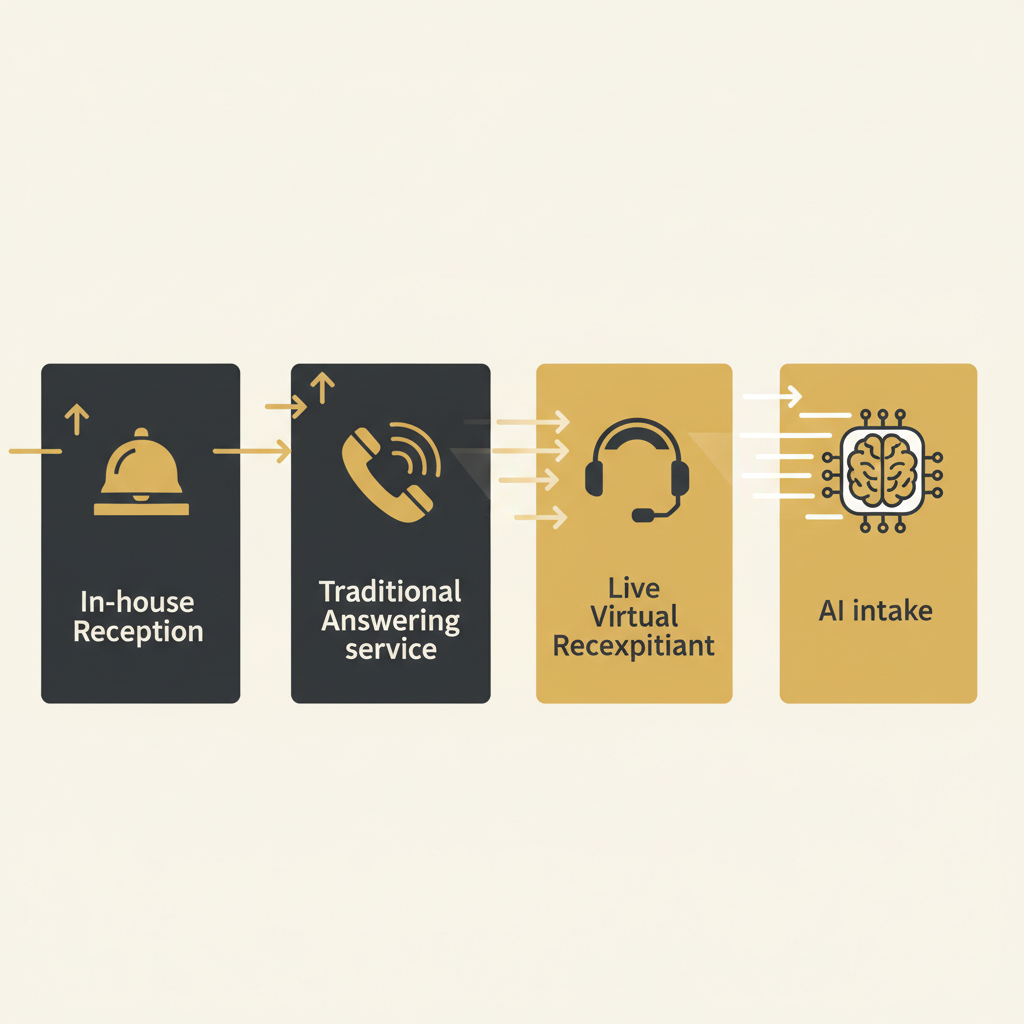
Firms generally choose among four intake models. Each trades cost against speed and qualification depth. The right answer is rarely a single option; it is usually a blend.
| Intake Model | Typical Monthly Cost | Pickup Speed | Qualification Depth | Best For |
|---|---|---|---|---|
| In-house reception only | Salary + benefits | Business hours only | High (trained staff) | Firms with steady daytime volume and no after-hours leads |
| Traditional answering service | $300-$800 | Fast | Low (message-taking) | Firms needing basic overflow and voicemail replacement |
| Live virtual receptionist | $360-$1,400 | Fast | High (scripted qualification) | Firms that want human empathy on sensitive PI calls |
| AI intake / AI receptionist | Lower per-minute, scalable | Under 5 seconds | Medium-high (scripted, CRM-synced) | Firms prioritizing 24/7 speed and instant CRM routing |
Pricing ranges above reflect commonly published 2025 to 2026 market rates for legal-specific providers and vary by call volume, minutes, and feature set. The pattern that matters: a human-only model maximizes empathy but costs the most per call, while AI maximizes speed and 24/7 coverage at the lowest marginal cost. An AI virtual receptionist can answer in under five seconds, ask qualifying questions, and book a consultation or escalate an emergency immediately.
The recurring lesson from firms we work with is that the most resilient setup pairs instant AI or live pickup for every call with human escalation for the emotionally sensitive injury conversations. Speed wins the first contact; empathy wins the retainer.
The Math: What an Answering Service Is Worth

The honest way to evaluate the investment is cost per signed case, not the monthly invoice. The inputs are simple, and the conclusion is consistent across PI markets.
Assume your firm fields 100 inbound inquiries per month and currently converts 20 into signed cases. Suppose 30% of those inquiries arrive after hours and hit voicemail, and you recover even half of them with live answering. That is roughly 15 additional qualified conversations per month and, at a conservative sign rate, three to five additional signed cases.
If your average PI case generates $8,000 in fees, three extra signed cases is $24,000 in monthly revenue against a service cost of a few hundred dollars. Independent research supports the lift: SimplyConvert's analysis of personal injury intake found that firms with a dedicated intake function and automated first-response convert at roughly 3.1 times the rate of firms where attorneys handle initial intake directly. The benchmark we hold for PI firms is that the answering service should pay for itself with a single recovered case per quarter; in practice it usually does so monthly. This is the same revenue logic that drives the broader lead generation for lawyers calculus: it is almost always cheaper to convert a lead you already paid for than to buy a new one.
Bilingual Intake: The Differentiator Most Firms Skip

In contested motor vehicle accident markets, the single most overlooked answering-service feature is bilingual coverage. A Spanish-speaking accident prospect who reaches an English-only line or a voicemail will simply call the next firm. The opportunity is large precisely because so few firms answer a Spanish call after 6 PM.
A legal answering service with native Spanish-speaking intake, paired with a Spanish-language follow-up sequence, captures a market segment most competitors structurally cannot reach. The handoff requirements are identical: collect the accident details in the prospect's language and push them into your CRM so the morning callback is in the right language with full context.
For firms building a serious presence in the Hispanic MVA market, bilingual after-hours intake is not an add-on. It is the front door. We cover the channel strategy that feeds it in our law firm marketing strategy guide, but the intake layer is where that strategy either converts or leaks.
How to Choose and Set Up an Answering Service
Picking a law firm answering service provider is less important than configuring the handoff correctly. A poorly integrated premium service underperforms a well-integrated basic one. Use this checklist before signing a contract.
- Require CRM integration. Every captured lead must flow directly into your CRM with the accident date, injury type, at-fault party, and prior-attorney status. Without it, you are paying for an expensive voicemail.
- Define the qualification script. Give the service your exact intake questions and your routing rules for urgent matters. Do not accept a generic legal script.
- Set escalation rules. Specify which calls warrant a live attorney transfer versus a scheduled callback, and the time windows for each.
- Confirm coverage hours. The whole point is the hours you do not cover. Verify true 24/7 or at minimum evenings and weekends.
- Test bilingual capability if you serve Spanish-speaking clients, with a real call, not a sales promise.
Start with after-hours and overflow coverage rather than replacing daytime staff. That captures the highest-leverage lost leads first, at the lowest cost, and lets you measure recovered cases before expanding. For the full funnel context, including response-time benchmarks and follow-up sequences, work through our law firm intake optimization guide alongside this one.
The Bottom Line
A law firm answering service solves one specific, expensive problem: prospects calling when no one is there to answer. With 35% of law firm calls going unanswered and accidents peaking in exactly the hours most firms go dark, the leak is real and measurable. The fix is inexpensive relative to the case value at stake, and it pays back fastest when it is configured to qualify and route, not merely to take messages.
Choose the model that fits your volume and budget, insist on CRM integration and a real qualification script, add bilingual coverage if you serve Spanish-speaking clients, and start with the after-hours window where the lost leads concentrate. Do that, and the service stops being a cost line and becomes one of the cheapest sources of signed cases your firm has. For a complete view of how intake connects to acquisition, see our guide to attorney lead generation.
Rafael Hernandez is the CEO and Co-Founder of Great Marketing AI, a performance marketing agency for personal injury law firms. Great Marketing AI specializes in Spanish-speaking MVA lead generation and has managed lead generation campaigns for PI firms across California, Texas, and Florida.
Turn Ad Spend Into Signed Cases
We blend AI-driven testing with proven performance strategy to attract qualified traffic and turn it into revenue—fast, trackable, and scalable.
- PI Lead Generation — exclusive, AI-qualified leads across MVA, slip & fall, med mal, and more.
- Facebook & Instagram Ads — reach customers where they scroll.
- Google Ads — capture people actively searching for you.
- Website Design — turn visitors into buyers with high-converting sites.
- AI Automations — save hours and never miss a follow-up.
- Email Marketing — nurture leads and close sales on autopilot.
- SEO — get found by customers searching for what you sell.
FAQs

About the author
Rafael Hernandez
CEO and Co-Founder of Great Marketing AI
Rafael Hernandez is the Founder of Great Marketing AI and a former Microsoft Engineer. He specializes in performance marketing for personal injury law firms, managing over $10M in ad spend to help attorneys generate signed cases across every PI case type. His strategies focus on exclusive lead generation, AI-powered qualification, and eliminating wasted budget.
About Great Marketing AI
Great Marketing AI: Performance marketing for personal injury law firms
We help personal injury law firms scale with exclusive, AI-qualified leads across every PI case type: MVA, slip & fall, medical malpractice, and wrongful death. Native English and Spanish campaigns, enterprise-grade Meta + Google ad management, and AI lead qualification before every intake.
100% Exclusive Leads
Never shared between firms. Territory-protected.
Native Spanish & English Campaigns
Built by native speakers, not Google Translate.
AI Lead Qualification
Pre-qualified before they ever reach your intake team.